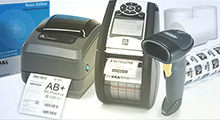
Media choices - Unique ID can provide the best solution for your needs

People are often confused when faced with the choice between direct thermal label printers and thermal transfer label printers, and which printer best suits their needs.

How do I choose between direct thermal and thermal transfer printing?

Direct thermal printing uses chemically treated, heat-sensitive media that blackens when it passes under the thermal printhead. Direct thermal printers have no ink, toner, or ribbon. Their simple design makes thermal printers durable and easy to use. Because there is no ribbon, direct thermal printers cost less to operate than inkjet, laser, impact, and thermal transfer printers. Most mobile printers use direct thermal technology.

Thermal media images may fade over time. If the label is overexposed to heat, light, or other catalysts, the material will darken and make the text or bar code unreadable. For these reasons, direct thermal printing is not used for lifetime identification applications. The readability of direct thermal labels, wristbands, and receipt papers varies greatly, depending on the usage conditions, but the technology provides ample lifespan for many common barcode printing applications including shipping labels, patient and visitor identification, receipts, and ticket printing.

For example, direct thermal labels can easily remain scannable after spending six months in storage in a distribution centre, and direct thermal patient wristbands have a special coating that makes them water- and chemical-resistant. Common thermal printing applications include: shipping labels, including compliance labels; receipts; pick tickets; coupons; event tickets; citations and parking tickets; name tags; visitor passes; and more. In thermal transfer printing, a thermal printhead applies heat to a ribbon, which melts ink onto the material to form the image. The ink is absorbed so that the image becomes part of the media.

This technique provides image quality and durability that is unmatched by other on-demand printing technologies. Thermal transfer printers can accept a wider variety of media than direct thermal models, including paper, polyester, and polypropylene materials. Thermal transfer printers can create extremely durable wristbands, asset tags, and certification labels, in addition to common labels, tags, and tickets. The specific label material and ribbon must be carefully matched to ensure print performance and durability. By selecting the right media-ribbon combination, as well as speciality adhesives, users can create archival-quality labels to withstand temperature extremes, ultraviolet exposure, chemicals, sterilization, and more.

Typical thermal transfer applications include: product identification; circuit board tracking; permanent identification; sample and file tracking; asset tagging; inventory identification; certification labels such as UL/CSA; laboratory specimens; cold storage and freezers; and outdoor applications.

Why is it important to use the correct ribbon type for the label media?

Because you need to match the qualities of the ribbon to the qualities of the label media and its usage in order to get the best results. The considerations are as follows:

a) Pure or High Wax ribbons transfer easily onto the print media but have generally poor qualities of adhesion, and so are most suitable for printing onto porous media (where the wax can be held by the pores). On semi-gloss, and especially on gloss material, the print may scratch or rub-off easily.

b) Pure or High Resin ribbons transfer less readily to the print media but adhere much more strongly. They are strongly resistant to smearing and scratching on most media (as well as having high resistance to heat and solvents) but have a low print density making them unsuitable for use with porous materials (where seepage into the pores leaves poor surface coverage). Because they have a high melting temperature, they are also not suited to high-speed printing.

c) Wax/Resin ribbons contain a mixed formulation of wax and resin and combine the properties of the two types. They typically give strong resistance to smear on most materials but may scratch readily, especially on high gloss materials.

Frequently asked questions for label, tags and ribbons

Q. What types of ribbon are available for thermal printing?

A. Wax, Wax/Resin and Resin

Q. Are colour ribbons available for thermal printing?

A. Yes, red, green, blue, yellow and some process colours.

Q. What ribbon is used on paper and tag stocks?

A. General purpose wax ribbon will give you the best print quality and the most scratch resistance.

Q. On light synthetics what ribbon can we use?

A. General purpose resin can be used to get the best print quality and the most scratch resistance.

Q. When printing polyester labels what ribbon can I use?

A. Poly resin ribbons must be used when printing on any shiny vinyl thermal stock.

Q. Can thermal transfer be printed on any printer?

A. No. The printer must be capable of using a ribbon to print.

Q. Can I print on labels that have my logo or other printing?

A. Yes, you can print on labels that have been preprinted on a press, as long as there is no printing in the way of the sensor.

Q. What label and ribbon do I use when I need to withstand harsh environment chemicals, such as gasoline, alcohol, UV rays?

A. For such environments, a polyester label and polyester resin ribbon must be used. A polyester label is made up of very strong vinyl, and if the ribbon has a high resin content, you will produce a very durable image, with up to a 5 year outdoor life.

Q. What sizes of ribbon available?

A. Ribbons are available from 38 to 220 mm and from 91 meters to 600 meters long. The size of the ribbon will depend on the type of printer you are using.

Q. What sizes of tags and labels are available?

A. Tags and labels are available from 25 to 216 mm wide and from 3/8” to 11” (9 to 279 mm) long.